NSDM
Evidence-bound decisions
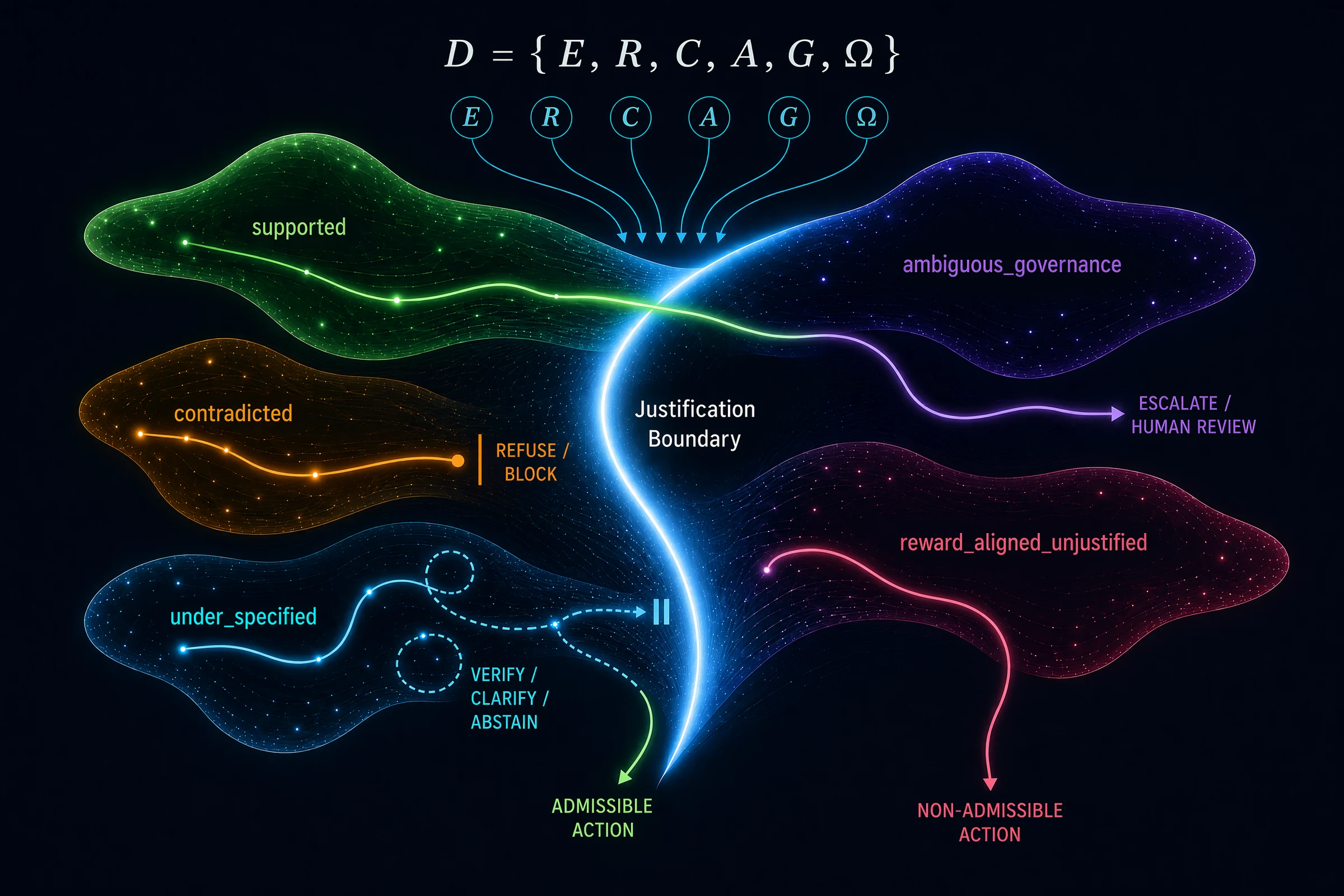
Determine whether a claim is supportable, whether a decision remains justified and whether an action is permitted under evidence, uncertainty, authority, policy and consequence.
Decisions need evidence. Execution needs proof. MetaForgeX investigates how neuro-symbolic decision systems, human judgement and accelerated computing can deliver actions that are supported, authorised and operationally defensible.
NSDM developed independently of neuromarketing. The wider programme connects decision research, behavioural applications and the machinery of execution through one question: what must hold before intelligence should act?

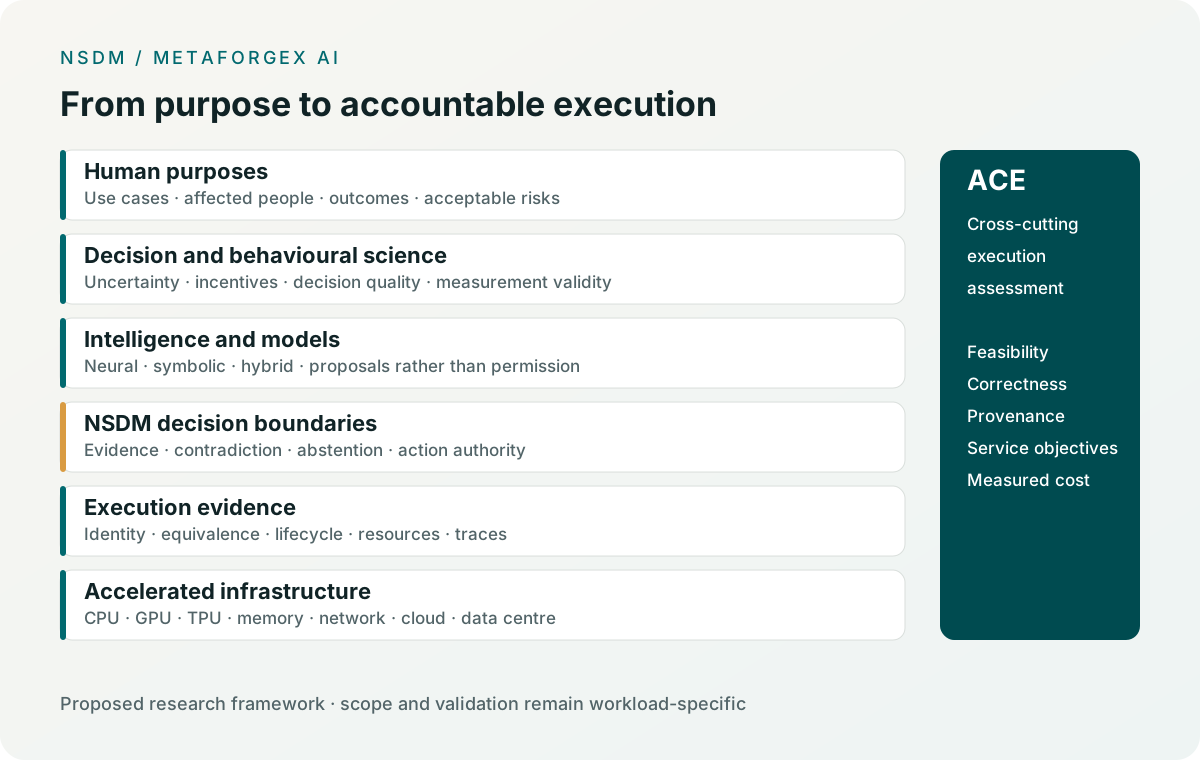
Model capability, decision authority and physical execution are different questions. Accelerated Computing Engineering (ACE) is our cross-cutting execution-evidence framework: connecting models, compilers, runtimes, memory, accelerators, networks and operations to correctness and useful outcomes. It does not replace NSDM's decision logic.
Determine whether a claim is supportable, whether a decision remains justified and whether an action is permitted under evidence, uncertainty, authority, policy and consequence.
Investigate whether a workload preserves semantics, request identity, effective resources and authority while meeting latency, reliability and cost constraints. Explore the execution framework →
Behavioural science and neuromarketing inform application-level questions about attention, trust, memory and intervention. Outcome economics asks whether correct execution produces accepted value. Explore applications →
Neural AI recognises patterns in language, images, behaviour, sound, video and data. Symbolic AI represents rules, definitions, permissions and logical relationships.
NSDM investigates how that combination can become a decision machine: testing evidence sufficiency, world-state validity, authority and consequence before answering, acting, abstaining or escalating. ACE then asks whether the chosen computational path preserves the decision contract.
NSDM uses Python, MATLAB, Wolfram, computer vision, symbolic computation, simulation and animated diagnostics to reveal what a model learned, where its decision boundary lies, how uncertainty changes, and why a proposed action passes or fails its evidence and governance checks.
NSDM now connects formal research to an executable governance kernel. The first accepted Workbench milestone separates authenticated identity from explicit Case-initiation authority and creates a tenant-scoped Case, AssessmentVersion v1 and CASE_CREATED AuditEvent as one governed transaction. Governed evidence, decision synthesis and Action Assurance remain subsequent milestones.
The paper programme is separated into working papers and planned manuscripts. No draft is presented as peer-reviewed or complete.
The original NSDM research remains the foundation: evidence-state distinctions, benchmark design and controlled action.
A boundary-complexity hypothesis with explicit assumptions, limitations and a falsifiable programme.
Conditional derivations and research questions, retained separately from empirical findings and infrastructure claims.
NSDM turns theory and benchmark data into concrete product, research, governance, and deployment work.
Classify failure cases, measure calibration, compare boundary behaviour, and publish reproducible findings.
Add evidence checks, abstention, refusal, escalation, and human review into product flows.
Use evidence ledgers, governance profiles, and deployment gates before scaling AI.
Inspect authority, accountability, contestability, cost, and consequence.
The way I would want any lab to disclose its methods: openly.
I use AI in the making of all MetaForgeX AI products and services, the way I use a spreadsheet or a search engine. The arguments, angles, opinions, and scars are mine—earned across decades spent building and interrogating technology, AI, enterprise architecture, research, neuroscience, neuromarketing, sponsorship, and marketing.
AI helps me research, pressure-test, and draft; I direct, cut, rewrite, and sign off on every word.
Material technical claims should be traceable to primary sources or committed experiment records. Measured results, simulation, external observations and hypotheses are labelled separately; limitations and corrections remain visible.
— The NeuroAlchemist, MetaForgeX AI
Follow the scientific programme and weekly evidence record →
My Substack explores human judgement, behavioural science, neuro-symbolic decisions and the infrastructure beneath increasingly capable AI. It is the editorial companion to this research journey: essays and field notes that connect technical questions to their human and commercial consequences.
The essays sit alongside our papers and experiments. Research findings, interpretation and future possibilities retain their distinct evidence status.
Discuss a bounded research collaboration or evidence-led pilot across decision systems, behavioural applications and accelerated infrastructure. GPU, TPU and cloud comparisons require workload-specific feasibility checks; future AGI and superintelligence scenarios remain research questions.
Johannesburg, South Africa