Numerics and architecture
Precision, conditioning, solvers, locality, dependency, memory hierarchy and parallel decomposition. Correctness and competing explanations precede performance claims.
Our expanded programme connects independent NSDM decision research to accelerated computing and the human purposes those systems serve. Each weekly record makes a question, artefact, limitation and next test visible.
Foundation Sprint 0 runs through 30 November 2026. The formal ACE core begins on 1 December, with evidence closure targeted for 31 October 2027. The locked 12 phases, eight platform lanes and 16 evidence gates remain the curriculum. Publication packages the work; it does not pass a gate.
Precision, conditioning, solvers, locality, dependency, memory hierarchy and parallel decomposition. Correctness and competing explanations precede performance claims.
CUDA, profiling, asynchronous execution, HIP/ROCm, JAX/TPU, LLVM, Triton and compiler-generated paths. Hardware comparisons require actual access and platform feasibility.
Linux, containers, topology, communication, admission, priority, effective demand and physical allocation/release. Simulation can test placement contracts, not physical fabric speed.
Model internals, batching, cache behaviour, request conservation, service objectives, telemetry, induced failures and recovery.
Actor/owner/delegation controls, reproducible deployment, capacity and cost per valid service-compliant outcome. Measured and estimated inputs stay separate.
Behavioural validity, consent, context, abstention and bounded autonomy. Neuromarketing is an application lane. AGI and superintelligence remain research scenarios rather than demonstrated capabilities.
Each issue pairs a website evidence entry with a NeuroAlchemist field note or experiment dispatch and a purposeful visual. Occasional longer essays explore a mature result. Experiments can span several weeks; protocols, failed hypotheses, unsupported configurations, replication audits and corrections are legitimate records.
Scientific graphs come from committed data and reproducible code. Exact diagrams explain mechanisms. Generated illustrations are labelled conceptual. Every issue separates measured results, external observations, inference and proposed work.
Read The NeuroAlchemist on Substack → · Inspect the admission checks →
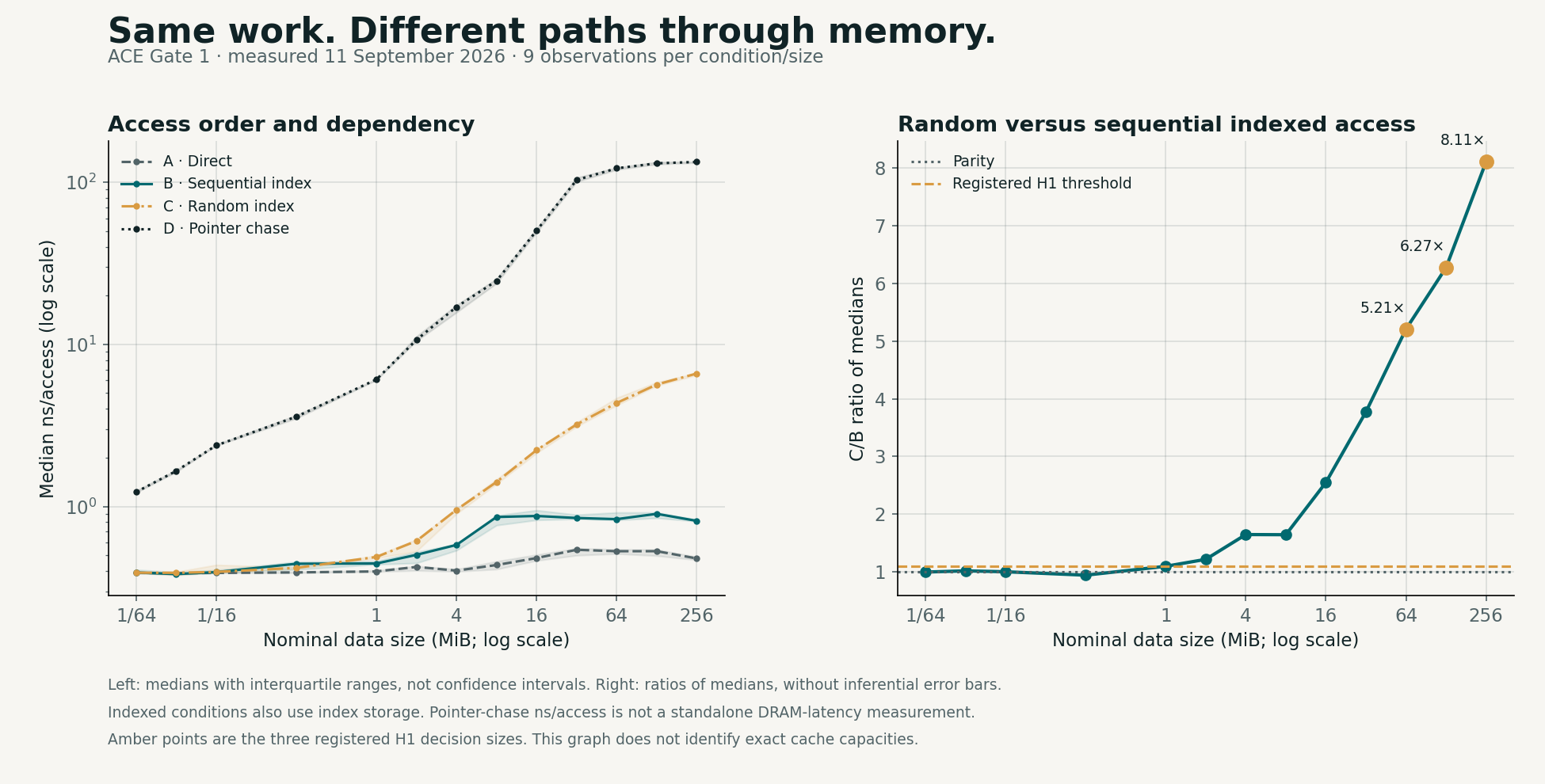
Status: measured CPU evidence from 11 September 2026, newly visualised from its committed dataset. New experiment executed: no. Gate 1 remains passed; the architecture sprint remains active.
Open full-size graph → · Open vector graph →
At the three registered largest nominal sizes, random indexed traversal was slower than sequential indexed traversal by ratios of 5.207, 6.273 and 8.107. This supports the registered H1 threshold for the recorded implementation. It does not identify an exact cache boundary, establish a universal DRAM-latency value or predict GPU performance.
The source records and plotting method remain inspectable. The graph preserves the complete size sweep, including near-parity conditions. Git-normalized and original Windows line-ending hashes are recorded separately; the experiment data has not been rewritten.
Editorial companion: “The machine must account for its work” is a prepared Substack field-note draft awaiting author sign-off. No published article URL is asserted.
Foundation competence comes first. The programme defines 14 reusable experiment families spanning numerical validity, parallel scaling, kernel diagnosis, concurrency, optimization admission, lifecycle/resource/authority conservation, topology, reliability, backend comparison, economics and behavioural validity. Every execution needs prerequisites, a reference, a falsifiable question and a platform-feasibility check.
Existing NSDM papers, experiment dates, null findings and research statuses remain intact. The next weekly record will follow actual progress rather than a promised result.
