C1 · Requests and lifecycle
Every submitted workload must reconcile to an explicit outcome. Track unique IDs and attempts; rejected, cancelled and failed work must remain visible. Retries must not silently inflate useful throughput.
A faster execution path is a candidate improvement. To accept it, first reconcile the workload, preserve its required semantics, account for its resources and verify the authority behind state-changing actions.
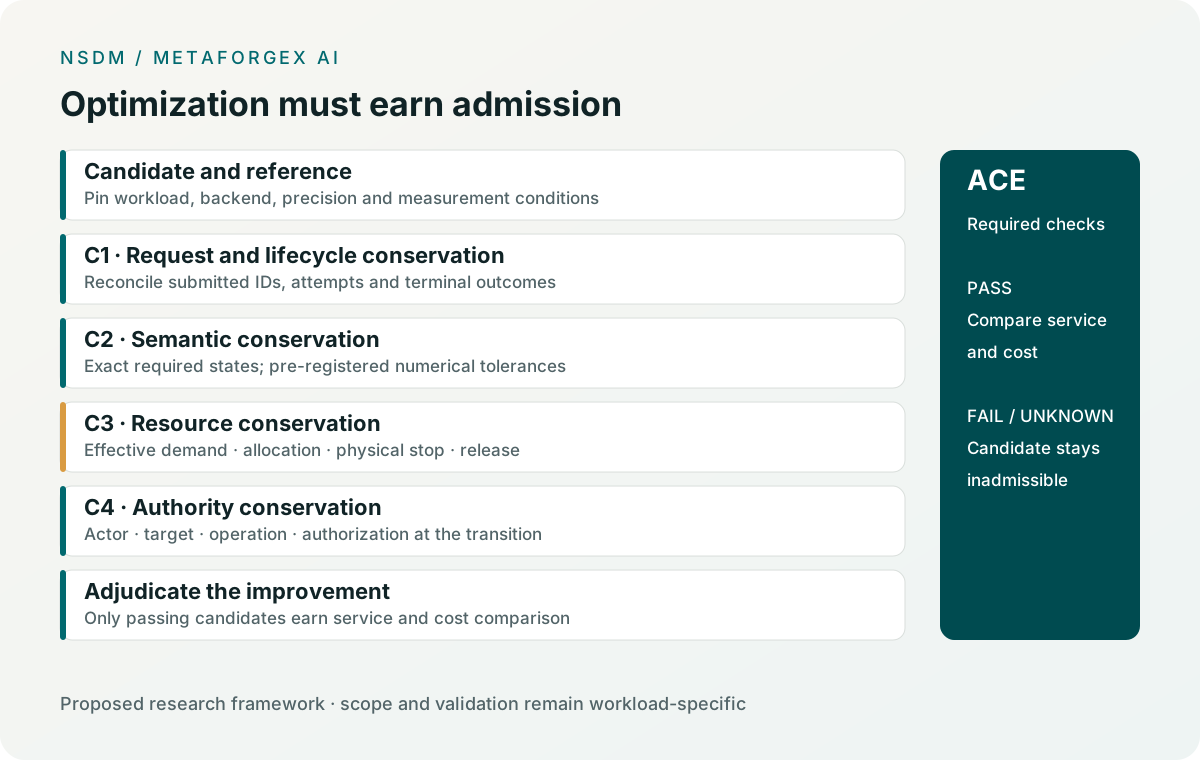
Every submitted workload must reconcile to an explicit outcome. Track unique IDs and attempts; rejected, cancelled and failed work must remain visible. Retries must not silently inflate useful throughput.
Compare the reference and candidate. Require exact agreement for specified discrete states such as contradiction, UNKNOWN, abstention, authority and final decision; pre-register tolerances for continuous scores.
Preserve effective demand across retry and requeue unless an explicit event changes it. Reconcile reservations, allocation and release with actual execution; logical eviction is not proof that physical work has stopped.
Discovery does not grant mutation rights. Record actor, target, operation and the authorization basis at the transition. Denied operations must leave governed state unchanged.
The original benchmark programme, findings, null results and working-paper status remain on the research page and in the publication library. The expanded direction does not upgrade their validation status.
A completed CPU experiment and written synthesis are recorded in the versioned Gate 1 evidence. This supports the measured implementation and platform; it is not a GPU, TPU or distributed-cluster result.
The topology research backlog records a simulation-first direction. Local prerequisites must pass Gate 0. Simulated placement is not measured network speed or cloud economics.
Request, resource, authority and optimization-admissibility harnesses are research specifications. External release defects motivate fixtures; they are not reproduced MetaForgeX failures until independently demonstrated.
For each backend, record the actual OS/kernel, hardware, driver, toolkit/runtime, compiler, libraries, framework, flags, workload version and available features. Establish compatibility for that exact configuration. A documented feature is not evidence that it runs on the current laptop.
Workload → reference → hardware/toolchain → optimization → owner/authority → effective resources → lifecycle → placement → trace → semantic result → service objective → allocation/release → failure → cost → outcome.
Keep failed checks and negative findings. Capture the actual execution backend, rather than only the intended configuration. Compare instrumentation overhead where it could change timing.
Latency, throughput, memory and cost can be measured during diagnosis. They can be called an accepted improvement only after required correctness checks pass and the comparison meets its pre-registered objective. A valid result with no improvement is still evidence.
Governed infrastructure assessment is a proposed capability. No production GPU-cluster competence, commercial savings or enterprise deployment is established by the schema alone. Reproducible local experiments must precede realistic platform replication.
The full scope and dated weekly record connect questions, protocols, experiments, graphs and editorial interpretation. Existing evidence keeps its original dates and limits.