1 · Human purposes and use cases
Behavioural science, neuromarketing, finance, healthcare and industrial systems define outcomes, affected people and acceptable risks. A conversion rate alone does not establish human benefit.
NSDM asks whether an action is justified. ACE asks whether its execution preserves the evidence, semantics, resources and authority that made it admissible. Behavioural and decision science help define what a useful outcome means.
NSDM developed as an independent decision-systems research programme. Neuromarketing is a separate application domain; it is not the origin of NSDM. Their connection is a workload-level question: how can AI support human decisions without confusing prediction, persuasion and justified action?
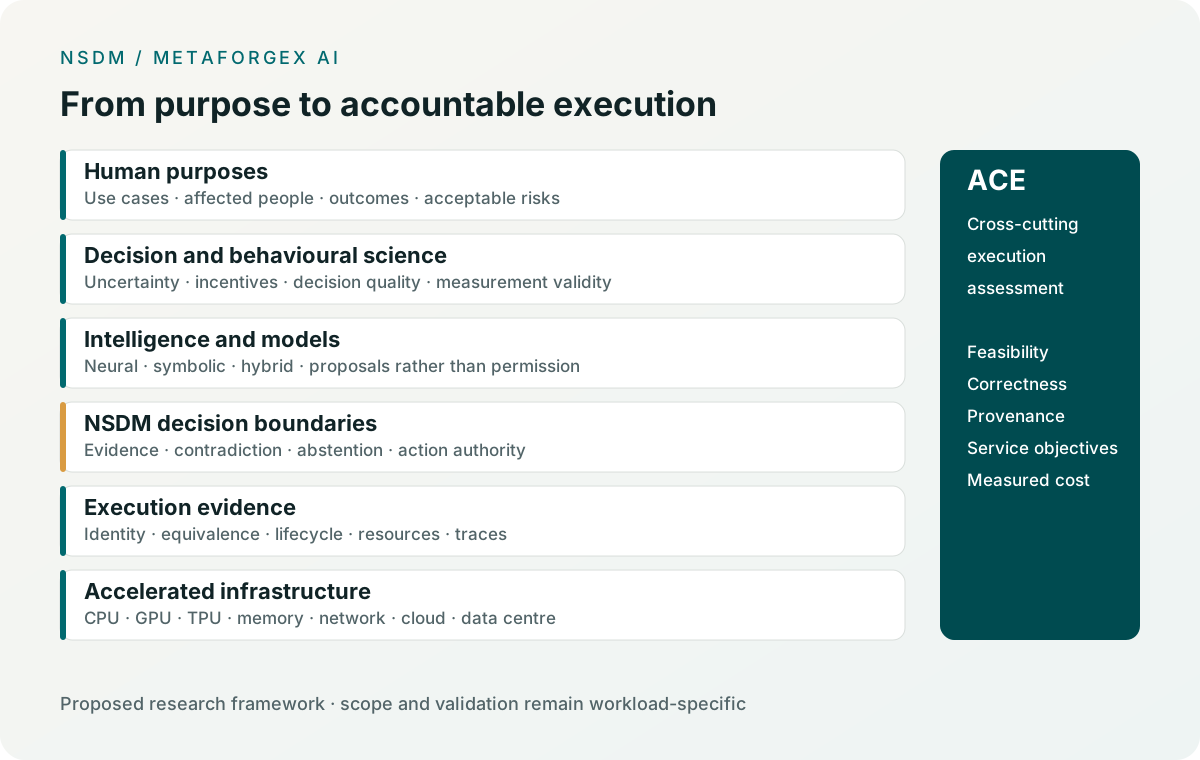
Behavioural science, neuromarketing, finance, healthcare and industrial systems define outcomes, affected people and acceptable risks. A conversion rate alone does not establish human benefit.
Study uncertainty, incentives, cognitive limits and decision quality. Validate measures for the population and context; psychological explanations are hypotheses to test.
Neural, symbolic and hybrid systems propose interpretations or actions. Model capability and confidence do not confer action authority.
Investigate support, contradiction, insufficient specification, abstention and authority before an action is admitted. Retain the existing papers and benchmark limitations.
Connect workload identity, reference output, actual backend, lifecycle, allocation, trace and terminal result. An optimization remains a candidate until required checks pass.
CPUs, GPUs, TPUs, memory, networks, cloud and data centres supply execution capacity. Select them by workload evidence, rather than treating more compute as better judgement.
ACE is the expanding engineering programme for studying how a justified workload travels through its compiler, runtime, accelerator, memory, scheduler and telemetry. It is a cross-cutting evidence framework, not a completed infrastructure product or a replacement for NSDM.
The proposed measure is useful, correct, authorised, traceable work delivered within an agreed service objective, relative to measured infrastructure cost. Utilisation is a diagnostic variable; it is not sufficient proof of efficiency.
Useful references for control logic, small workloads and local processing. Measure memory locality and deployment constraints before assuming acceleration is warranted.
A candidate for parallel numerical work and model execution. Test numerical precision, memory capacity, concurrency and host/device transfers against a reference.
Future comparators when access, supported operators and compiler/runtime behaviour are established. No TPU benchmark is claimed here.
Add placement, network topology, queueing, isolation, data residency and cost attribution. Simulated placement can test provenance; only physical experiments can establish fabric performance.