01 · Perception
Learn from uncertain inputs
Neural models interpret text, images, audio, behaviour, telemetry or other complex signals and produce candidate facts, features, predictions or plans.
A Neurosymbolic Decision Machine, or NSDM, is an AI system that combines learned perception with explicit reasoning and then checks whether its evidence, model of the world, authority and consequences justify what it proposes to do.
The central distinction is simple: being able to answer, generate, recommend, simulate or act is not the same as being justified in doing so.
An NSDM converts perception and reasoning into a controlled decision only when the relevant conditions are sufficiently established for the consequence of being wrong.
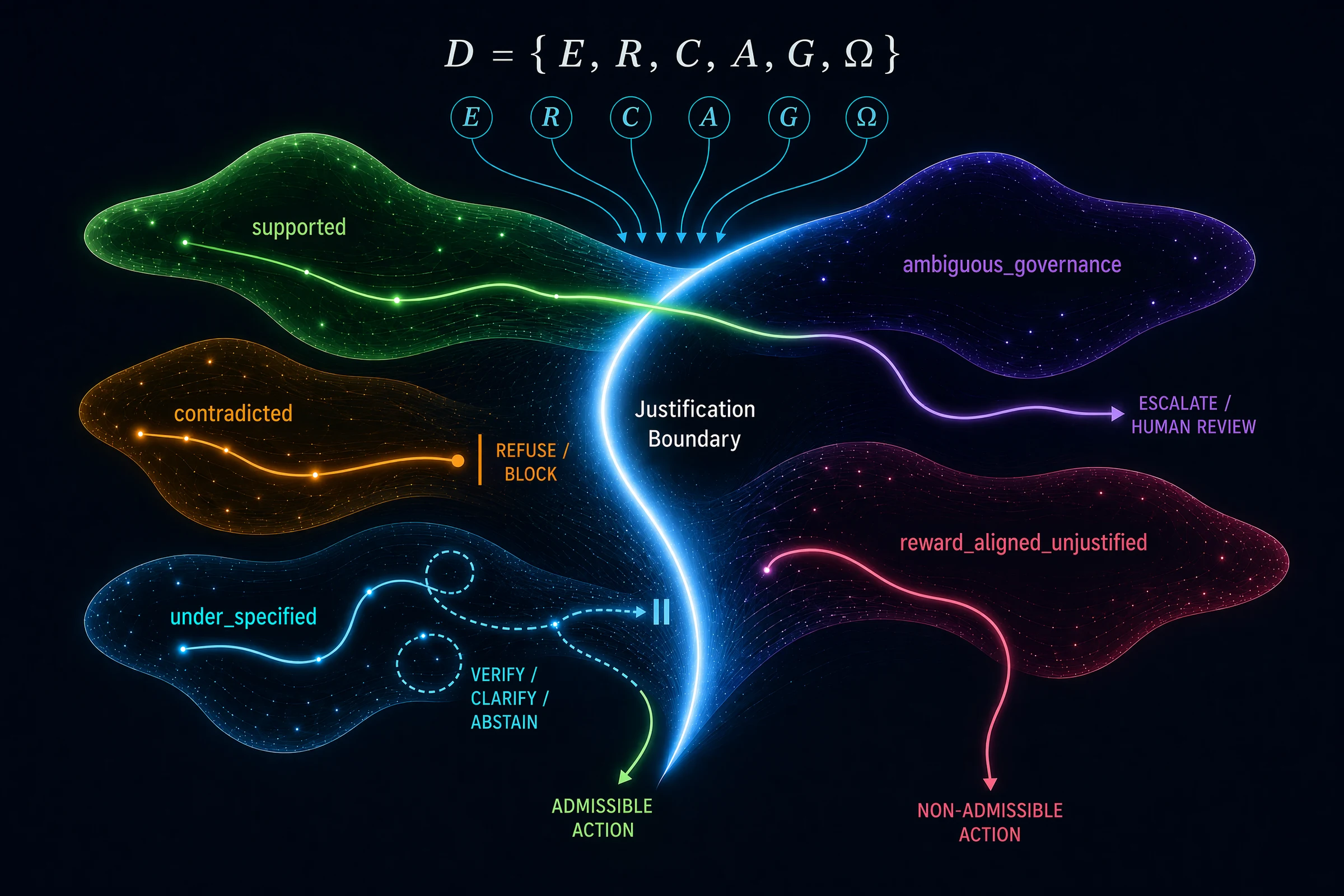
The architecture can vary, but a decision machine must represent more than a model prediction or a chain of generated reasoning.
Neural models interpret text, images, audio, behaviour, telemetry or other complex signals and produce candidate facts, features, predictions or plans.
Relevant entities, claims, premises, relationships, uncertainty, time, source provenance and proposed actions are represented so they can be checked.
Rules, knowledge graphs, policies, temporal logic, causal assumptions, programmes or other symbolic methods test consistency and derive consequences.
The system evaluates evidence sufficiency, contradiction, missing premises, world-state validity, authority, uncertainty and the cost of being wrong.
The outcome is not limited to yes or no. It can answer, verify, clarify, abstain, refuse, escalate, pause, allow or block.
A reproducible evidence and decision record identifies the sources, model, rules, boundary state, action and claim limits that produced the outcome.
Neuro-symbolic AI combines neural pattern recognition with symbolic facts, rules, relationships, constraints or programmes. Its objective may be more accurate prediction, compositional reasoning, planning, interpretability or rule-compliant generation.
NSDM asks whether the premises are supported, whether the world model is valid for this decision, whether the actor has authority, what happens if the system is wrong and which action is therefore permitted now.
NSDM separates the state of the evidence from the state of governance and the action the system is allowed to take. This prevents a confident output from being mistaken for a justified decision.
A decision system should not be forced to fabricate certainty when the correct outcome is to stop, ask, verify or transfer control.
Proceed when the evidence, authority, world state and consequence threshold are satisfied.
Request a missing premise, retrieve stronger evidence or test an unresolved contradiction.
Do not produce the requested output when support is insufficient or the action is prohibited.
Transfer the decision to an authorised human or prevent execution when consequence or governance demands it.
The category is a research and engineering programme, not a claim that one architecture solves truth, safety or governance.
Symbolic reasoning cannot repair false premises, incomplete evidence or an invalid representation of the world.
A readable chain can describe a process without revealing the actual causal basis of a neural model’s behaviour.
Safety depends on the task, environment, actors, controls, failure modes and consequences—not on the label attached to the architecture.
No. It is an architectural and decision-assurance framework. Different neural, symbolic, causal, probabilistic and rule-based components may implement the required functions.
No. The required threshold should increase with uncertainty, irreversibility, vulnerability and the consequence of being wrong.
Yes. A language model may provide perception, extraction, generation or planning, while the surrounding NSDM evaluates evidence, policy, context and permitted action.
Because a decision system that hides uncertainty or failed thresholds cannot distinguish evidence from aspiration. A disciplined non-result is part of the assurance record.
The definition becomes useful only when it is converted into datasets, benchmarks, experimental gates, governance objects and controlled product behaviour.